Choosing a water vapor permeability tester is not simply a matter of comparing chamber size, display type or price. The right instrument must reproduce the test method required by your products, handle your actual materials and generate results that your laboratory can repeat and document.
For textile laboratories, nonwoven manufacturers, packaging suppliers and material-testing facilities, the key purchasing question is this: will the WVTR tester measure the water vapor transmission behavior that matters to my product under the conditions specified in my test plan?
Start with the required standard and test conditions. Then match the measurement method, specimen fixtures, environmental control and weighing capability to your materials. Finally, evaluate automation, reporting, service and total operating cost.
1. Start with the Test Standard
Before comparing a water vapor transmission rate tester, confirm the standard and edition named in the customer specification, product requirement or laboratory procedure. ASTM E96/E96M is a gravimetric method: a specimen is mounted over a test cup, a vapor-pressure difference is established across it, and the change in cup mass is measured over time.
ASTM E96/E96M provides two basic approaches: the Desiccant Method and the Water Method. An instrument intended for ASTM E96 testing therefore needs a suitable cup-based arrangement, controlled test conditions and a weighing process appropriate to the expected mass change. Do not assume that a fast sensor-based WVTR instrument follows the same measurement principle or automatically satisfies an ASTM E96 requirement.
2. Match the WVTR Tester to Your Material
Before requesting a quotation, define the materials you plan to test and how they behave during specimen preparation.
Material category: woven and knitted fabrics, nonwovens, membranes, films, paper, coatings, foams or construction materials.
Specimen properties: thickness, flexibility, porosity, surface texture and tendency to absorb water or deform.
Measurement expectation: the likely WVTR range, required specimen dimensions and effective test area.
Mounting requirements: whether the sample can be clamped securely and sealed without blocking or damaging the test area.
For fabrics and nonwovens, pay particular attention to the cup assembly and edge sealing. A leak around the specimen can create a vapor path that bypasses the material and affects the calculated result.
3. Decide Whether You Need the Dry-Cup Method, Wet-Cup Method or Both
The Desiccant Method is commonly called the dry-cup method. A dry desiccant is placed inside the cup, and water vapor passing through the specimen is absorbed by the desiccant. The cup assembly typically gains mass during the test.
The Water Method is commonly called the wet-cup method. Water is placed inside the cup, and vapor moves outward through the specimen into the surrounding environment. The cup assembly typically loses mass.
These methods create different humidity conditions and vapor-flow directions. Their results are not interchangeable. When purchasing an automatic water vapor permeability tester, ask whether both methods are supported, which cup sets are available, and whether the required seals and accessories are included in the quotation.
4. Check Temperature, Relative Humidity and Airflow Control
Temperature and relative humidity determine the vapor-pressure difference driving moisture through the specimen. A fluctuation in either condition can affect the measured WVTR. A wide operating range is useful, but stable control at your actual test points is more important than a broad specification alone.
Air movement above the specimen can also influence the boundary layer. Ask how airflow is adjusted or controlled, how test conditions are monitored, and how the instrument maintains a consistent environment when several test cups are used at the same time.
5. Match Weighing Sensitivity to the Expected WVTR
In a gravimetric test, the balance measures the mass change associated with water vapor transmission. Materials with a high moisture-barrier performance may produce a very small mass change, making weighing resolution and handling control especially important.
Is the balance integrated, supplied as standard or purchased separately?
What weighing resolution is suitable for the lowest WVTR expected in your application?
What practical measurement range can be demonstrated with representative specimens?
Can the required mass-change rate be established within the laboratory’s acceptable test period?
6. Inspect the Test Cups, Sealing and Effective Test Area
The WVTR calculation is based on the effective area through which vapor is intended to pass. If the specimen is not mounted consistently, vapor may travel around its edges instead of through the material. This can undermine repeatability even when the chamber temperature and humidity are stable.
Look for clearly defined test areas, cup assemblies suitable for your specimen type, dependable sealing components and a repeatable clamping procedure. Easy cleaning and straightforward replacement of seals are also useful for routine laboratory work.
7. Consider Automation, Throughput and Data Management
The best configuration depends on how many specimens your laboratory processes and how much operator time is available. A manual system may be adequate for occasional testing. Laboratories with frequent testing or multiple sample types may benefit from automatic weighing, automatic condition control and software-based data recording.
How many specimens must be tested per day or week?
How many test stations or cup positions are required?
Can the system record test conditions and mass changes with timestamps?
Does the software calculate WVTR and export test reports?
Automation does not change the underlying gravimetric principle, but it can reduce disturbances caused by manual handling, chamber-door opening and data transcription. Multi-station capacity should also be considered alongside chamber uniformity.
8. Evaluate the Total Cost of Ownership
The purchase price is only one part of the investment. Include the balance and accessories, test cups, sealing rings, desiccant, calibration, installation, operator training, spare parts, software, maintenance and technical support. Check the required laboratory space, power supply and environmental conditions before ordering.
Is the UTSTESTER M029 Suitable for Your WVTR Testing Work?
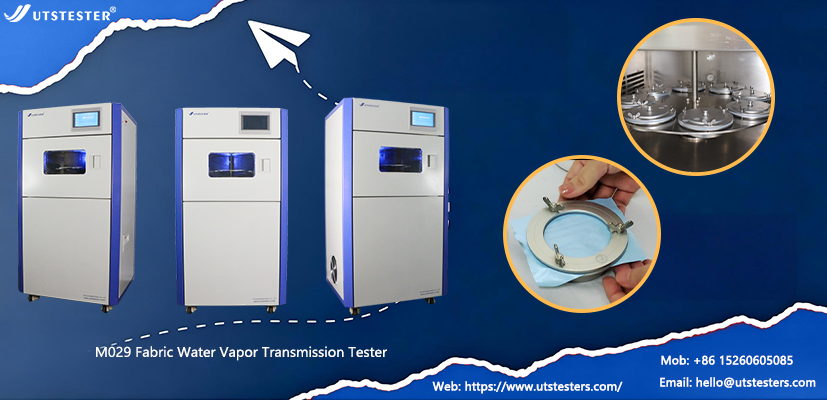
The UTSTESTER M029 Water Vapor Transmission Rate (WVTR) Tester is designed for water vapor transmission testing of fabrics and nonwovens and supports ASTM E96 testing. According to its supplied product information, the system features adjustable airflow, automatic humidity control and different test-cup configurations to accommodate laboratory workloads.
The most suitable configuration depends on the material, test method, required temperature and humidity conditions, Looking for an ASTM E96 WVTR tester for fabrics, nonwovens or other sheet materials? Contact UTSTESTER with your sample type, required standard, target conditions and testing volume to discuss a suitable M029 configuration.
Frequently Asked Questions About Choosing a WVTR Tester
What is the difference between WVTR, water vapor permeance and water vapor permeability?
WVTR is the water vapor mass flow through a unit area over a unit of time under specified test conditions, commonly reported in g/(m²·24 h). Water vapor permeance accounts for the vapor-pressure difference driving transmission. Water vapor permeability also accounts for specimen thickness. These values describe different quantities and should not be compared as though they were identical.
Can an ASTM E96 tester be used for textile fabrics?
Textile laboratories may use ASTM E96 when a customer or product specification calls for it. However, ASTM E96 is not a textile-specific comfort test. For textile quality-control testing, ISO 15496 may be relevant; for steady-state thermal and water-vapor resistance associated with clothing and similar products, consult ISO 11092 and the applicable product specification.
Is an automatic WVTR tester always more accurate than a manual tester?
Automation does not by itself guarantee accuracy. Both systems must use an appropriate method, suitable weighing capability and stable test conditions. Automatic weighing and data recording can, however, reduce operator-related variation and improve the consistency and traceability of routine testing.
Can one WVTR tester perform both dry-cup and wet-cup tests?
Some gravimetric systems can use interchangeable cup assemblies for both methods, while others are configured for only one method. Confirm the available cup types, sealing accessories and operating instructions for the exact model being quoted.
Does a sensor-based WVTR instrument meet ASTM E96?
Not simply because it reports a WVTR value. ASTM E96/E96M is gravimetric. ASTM F1249, for example, uses a modulated infrared sensor for water vapor transmission testing of flexible barrier films and sheeting. The required method must match the customer specification.
Email: hello@utstesters.com
Direct: + 86 152 6060 5085
Tel: +86-596-7686689
Web: www.utstesters.com


 +86 152 6060 5085

 English
 русский
 español
 português
 العربية
 Polski




 hello@utstesters.com
 hello@utstesters.com
 +86 152 6060 5085
 +8615260605085
